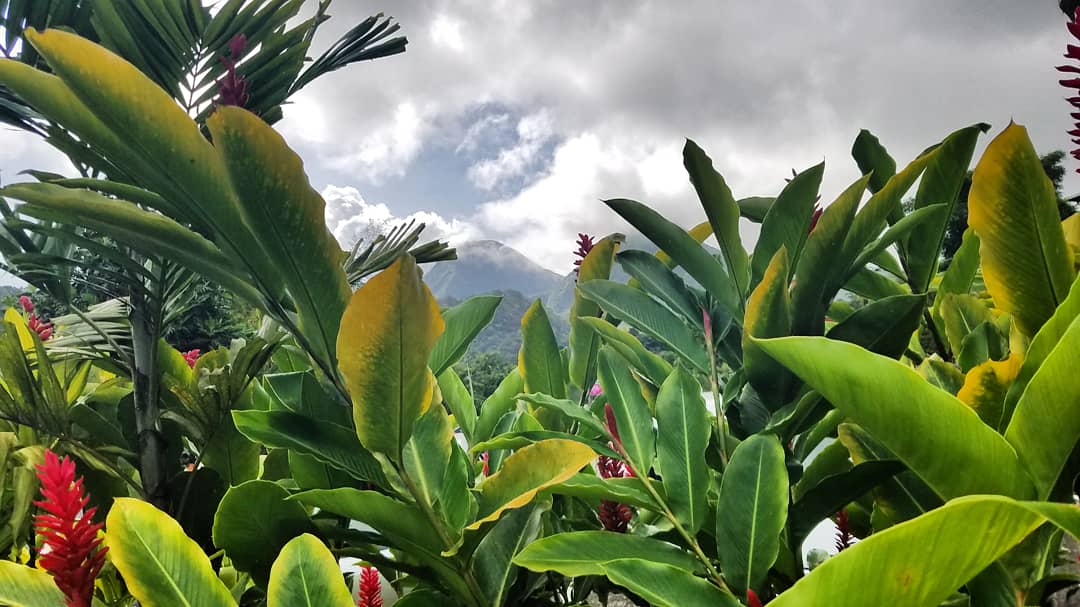
While the Caribbean may be perceived as beautiful and lush, the history and legacies of colonization in the region reveal a complicated underside. Colonialism and capitalism have shaped relationships between humans and land, tying patterns of domination to both environment and gender. It is critical to understand this history when considering the overt effects of climate change today, and it is crucial to include the humanities and social sciences in these discussions.
This bilingual digital humanities project aims to interrogate questions of capitalism, colonialism, gender, and environment in the Francophone Caribbean. The project’s goal is to uncover nuanced ways in which narratives of ecology and gender have been systematically suppressed and reduced—and conversely, to examine how these same narratives continuously resist and disorder dominant structures of power. To do this, we will look at four subtopics: sugar, bananas, beaches, and gardens. These commodities and spaces that are foundational to common imaginaries of the Caribbean. But they are also symbols of more complex histories, representing the direct social, cultural, and ecological consequences.
What can you expect from this site?
We plan to choose one theme with two interventions per year starting during the 2025-2026 academic year. Alongside these interventions, we will develop resources that will allow the intervention to be used as a pedagogical tool in both university and high school courses.
The 2025-2026 academic year Ecologies Entrelacées theme will be chlordécone with the guiding question: how do art and digital projects play a role in drawing awareness of chlordécone pollution? For more information about this theme and these interventions, visit the dedicate theme page here. We also hope this space can build community around our themes through virtual events and book clubs and welcome collaborators.
Future themes and interventions under consideration include gardens, using and healing with plants, bakoua, and sargassum, but we are always open to other ideas for themes and collaborations, so if you have an idea and would like to collaborate, please feel free to e-mail us at ecologiesentrelacees@gmail.com.
Background:
In the 2020 spring semester, Rachel Kirk and Eirann Cohen met in a course at Columbia University on the topic of “Disorderly Women” in Caribbean Literature, taught by Professor Kaiama L. Glover. This course explored the way in which female voices and figures disrupt traditionally masculine literary narratives, looking at the way in which troubling female characters may reflect or shed light onto the social and historical context of the region. Through our studies, we noticed strong connections between the subjugation of the female figures we were reading with patterns of ecological destruction, as well as disorder and resistance to this subjugation. In noticing these patterns, we wanted to explore this further through this platform. Our project continued to grow in the Fall of 2020, when we took a course called “The Caribbean Digital” with Professor Kaiama Glover and Professor Alex Gil. This course examined the Caribbean as a fluid geo-cultural space, interrogating the role of the internet in disrupting traditional structures of power. Here, we met Soraya Limare. Soraya’s overlapping research interests on gender and Francophone literature from the Caribbean, as well as her experience with digital humanities projects, inspired a collaboration.
During this period, Ecologies Entrelacées developed several interventions on our sub-themes of sugar, bananas, and gardens with prominent scholars, artists, and writers in Caribbean and Francophone Studies. After 2022, the site and project remained dormant and we have learned about the necessity flexible timelines for digital humanities projects, as well as how easy it is to underestimate the time, labor, and financial aspects of these projects. However over the years, we developed more partnerships with scholars, writers, artists, and fellow students who have influenced the next iteration of this project.
In our new iteration of Ecologies Entrelacées for 2025 and onward, we aim to make the project a collaborative pedagogical resource for environmental justice, gender studies, French studies, and Caribbean studies with continued interventions on environmental justice in the Francophone Caribbean, a guiding theme for each calendar year, and a larger community of collaborators.
Why the Francophone Caribbean?
The Francophone Caribbean was chosen as our area of focus because of our academic specializations in the space, and our proficiency in the language. Additionally, at a time when France has regularly touted its global leadership role in the fight against climate change, with President Emmanuel Macron urging us that “there’s no planet B” and that we should “make our planet great again,” our themes in the context of the Francophone Caribbean force us to question this narrative. We are raising questions around the ways in which France has secured this global leadership role at the expense of both women and landscape in the Caribbean. While centering the francophonie focuses the scope of this project to some degree, we also think it’s important to include other areas of the Caribbean in our exploration of these questions. Language barriers and drawn national boundaries don’t stop the flow of information, nor do they block the spread of environmental harms such as rising sea levels and chemical poisoning.
Acknowledgments:
We would like to acknowledge the following experts whose academic and professional work and mentorship have informed and inspired the creation of this platform:
Dr. Kaiama L. Glover, Professor of African American Studies, Yale University
Dr. Alex Gil, Associate Research Faculty of Digital Humanities in the Department of Spanish and Portuguese, Yale University
Dr. Jennifer Boum-Make, Assistant Professor of French and Francophone Studies, Georgetown University
Dr. Schuyler Esprit, Founder and Director of Create Caribbean Research Institute and Professor at the University of the West Indies Open Campus
Dr. Myriam Moïse, Associate Professor of English at the Université des Antilles in Martinique
 Ecologies Entrelacées