Heartland: An Almanac for Caribbean Futures
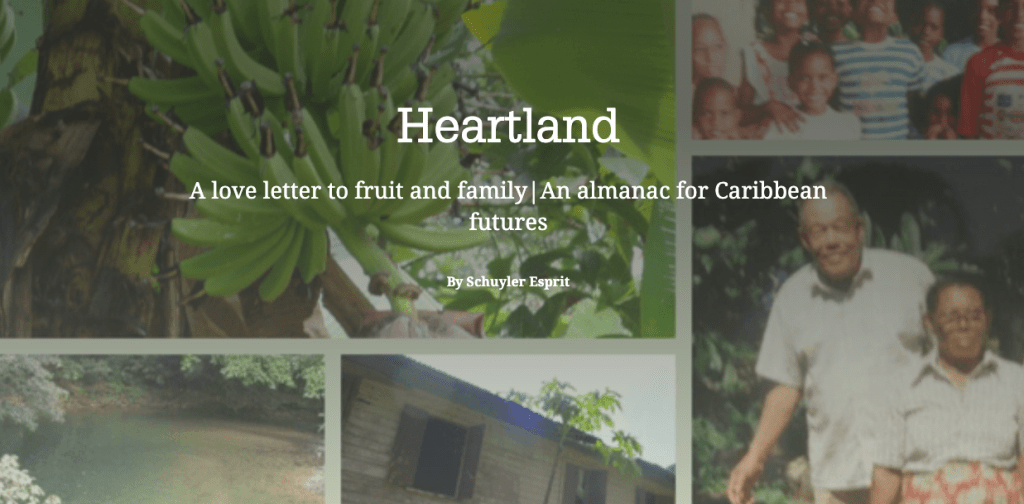
For this intervention, Dr. Schuyler Esprit presented Heartland: An Almanac for Caribbean Futures. Heartland, uses family stories and genealogy as a point of departure to explore the history of the land in the Caribbean. The project will look at agriculture, ecology, and economy through the lens of a once-thriving commercial banana farm that was also the heartbeat of the family who owned and worked the land. Heartland illuminates the ways that the history of plantation slavery, maroon ideology and Creole sensibilities bear upon Caribbean families as they navigate the success and failures of the banana industry. It generates questions about how Caribbean people’s connections to land and water have helped them survive and thrive amidst environmental change, as well as political and economic neglect and instability. A return to the almanac, the guiding text of the banana estate, allows an imagining of the Caribbean’s relationship to land and agriculture. The almanac has guided farmers for centuries with its three-pronged approach to crop production and synergetic farm planning: agricultural science, astronomy and climate science. Heartland frames the history of family, community and nation/region at the intersection of the real and symbolic agriculture (earth, labor, grounding), astronomy (material resources and institutional frameworks), and climate (shifting environmental and social contexts). This digital love letter to fruit and family is also evidence of the myriad challenges and promises of postcolonial resilience, survival and reinvention.
Visit Heartland: An Almanac for Caribbean Futures here.
This presentation is designed as an interactive alternative to a synchronous lecture format for Ecologies Entrelacées. It is part of a larger work in progress. Because it exists in this digital space, she may, from time to time, enhance this version with additions from the larger work. The final version of the project will be shared on the Carisealand project website. Please also visit Carisealand to see some of the amazing other digital humanities work that Dr. Esprit has done with other colleagues over the years.
Many thanks to your co-sponsor for this intervention, the Institute for Religion, Culture, and Public Life at Columbia University.
 Ecologies Entrelacées
Leave a comment